


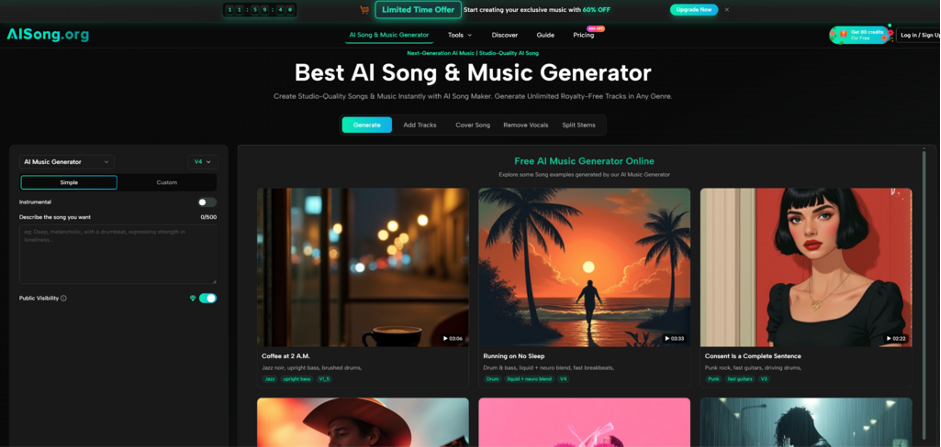
For decades, the ability to compose original music sat behind a wall of prerequisites: years of instrumental practice, fluency in music theory, access to recording studios, and proficiency in complex digital audio workstations. That wall is crumbling. Not because the skills became obsolete, but because a new class of tools lets people describe music with plain words and hear it materialize within minutes. The AI Song Generator belongs to this emerging category, and its quiet significance lies in who it now invites into the creative process—people who never imagined they could make a song.
Table of Contents
What It Means to Compose Without a Composer’s Background
Music creation has historically been bottlenecked by formal training. A teacher wanting a custom goodbye song for her kindergarten class, a couple wanting a unique first-dance track for their wedding, or a small business owner needing a jingle all faced the same barrier: they could imagine the outcome but could not execute it. Text-to-music tools collapse that gap. The creative act shifts from manipulating notes on a staff to articulating a feeling in a sentence. This does not replace trained musicians; it adds a parallel lane for expression that operates on a different set of skills—linguistic description, emotional clarity, and iterative refinement through natural conversation with a machine.
The Three-Step Path from a Thought to a Song
The platform’s interface strips music production to its cognitive essentials. No menus, no instrument selections, no timeline editing. Just a prompt field and a generate button, followed by a download. This design philosophy prioritizes psychological safety for first-time users over power-user configurability.
Step 1: Articulate the Idea in Plain Language
The first prompt serves as a creative brief. Users type what they want to hear, using mood words, genre labels, tempo hints, or narrative scenarios. The system does not require structured commands.
How Non-Musicians Navigate the Description Process
A beginner might type “a happy song to celebrate graduating from university.” A slightly more confident user might add “indie pop with clapping and joyful piano.” The platform appears to treat these inputs as holistic guidance, mapping everyday language to musical parameters behind the scenes. In testing with deliberately vague prompts, the engine consistently produced tracks that matched the requested emotional arc, even when genre cues were minimal. This is crucial because it validates the linguistic approach—users do not need to learn a new technical vocabulary to get usable results.
Step 2: Witness the Generation Unfold
After submission, the AI handles composition, arrangement, instrumentation, vocal synthesis when relevant, and mastering. There is no user intervention required during this phase, which reinforces the sense of magic for first-timers and efficiency for repeat users.
The Emotional Experience of Hearing Your Words Become Music
The most underappreciated aspect of using an AI Song Maker is the moment of first playback. When a kindergarten teacher hears a cheerful, professionally produced song built around the names of her students—names she typed into the prompt field two minutes earlier—the reaction is qualitatively different from browsing a stock library. It feels like co-creation, even if the user’s role was purely descriptive. The 44.1kHz output arrives polished and radio-ready, with vocal lines that sit cleanly in the mix. The quality level is sufficient that casual listeners on social media or at a small event would not instinctively label it as synthetic, even if audiophile scrutiny would reveal generative artifacts in sibilance or reverb tails.
Step 3: Own and Share the Result
The final step delivers an MP3 file with no watermark and full commercial rights. For personal use cases, this means the song is truly theirs to keep, gift, or share. For professional scenarios, it means the track can appear in monetized content without legal friction. A built-in converter to WAV format ensures the audio meets higher fidelity standards when needed, further lowering the exit barrier toward practical use.
From Private Experiment to Public Soundtrack
The licensing terms—explicitly covering commercial projects, social media, and redistribution—give users permission to share their creations widely. The free tier’s public visibility requirement means that early experiments are visible to the community, which can be either a feature (collaborative inspiration) or a limitation (privacy for surprise gifts), depending on the scenario.
Comparing the On-Ramp for Different User Profiles
Different music creation paths impose vastly different starting costs in time and skill. The following comparison frames the tool against alternatives from the perspective of an absolute beginner.
| On-Ramp | Required Training | Time to First Result | Emotional Barrier | Cost for Commercial Use |
| Traditional Instrument | Years | Months to years | High (performance anxiety) | Free once skilled |
| Digital Audio Workstation | Weeks to learn software | Days to weeks | High (interface complexity) | Varies |
| Stock Music Library | None | Minutes (searching) | Low (generic results) | Subscription or per-track |
| AI Song Generator | None (plain text) | Minutes (generation) | Low (descriptive, no judgment) | Free (with public visibility) |
Where the Tool Serves as a Creative Equalizer
The most meaningful impact shows up in scenarios where traditional music creation was never an option. A teacher in a underfunded school can generate educational songs tailored to that week’s lesson—multiplication tables set to pop, history facts set to hip-hop—without any budget or musical background. A community theater group staging an original play can create a complete soundtrack that matches their script’s emotional beats, then perform to it without worrying about performance rights. A family compiling a memorial video can generate a piece of music that feels personal and specific, rather than settling for a generic track that almost fits. In each case, the tool serves less as a production instrument and more as an accessibility ramp into musical expression.
The Honest Limits of Word-to-Music Technology
The technology is not a magic wand. Prompts that are too vague can yield results that feel generic, much like giving unclear direction to a human composer would. Complex musical instructions—“use a Lydian mode,” “add a metric modulation in the bridge”—fall outside the system’s reliable interpretive range, because it treats prompts as creative inspiration rather than technical score. The generative process is probabilistic; two generations from the same prompt will sound related but not identical, which can frustrate users seeking an exact, reproducible output. The lack of stem export means a user cannot take a generated track into a DAW to tweak the bassline or replace the vocalist. These constraints matter most to users who want to treat the output as raw material for further production, rather than as a finished product. For the teacher, the family, or the small business owner, the finished product is precisely the point.
Redefining Who Gets to Call Themselves a Creator
The AI Song Generator does not claim to produce chart-topping hits or replace studio craftsmanship. Its quieter contribution is to shift the question from “Can you make music?” to “What do you want to say with it?” By translating everyday language into listenable, licensable audio, it invites a far broader population into a creative domain that was historically gated. For the classroom, the small stage, the personal milestone, and the casual social post, that invitation is more than enough.
