


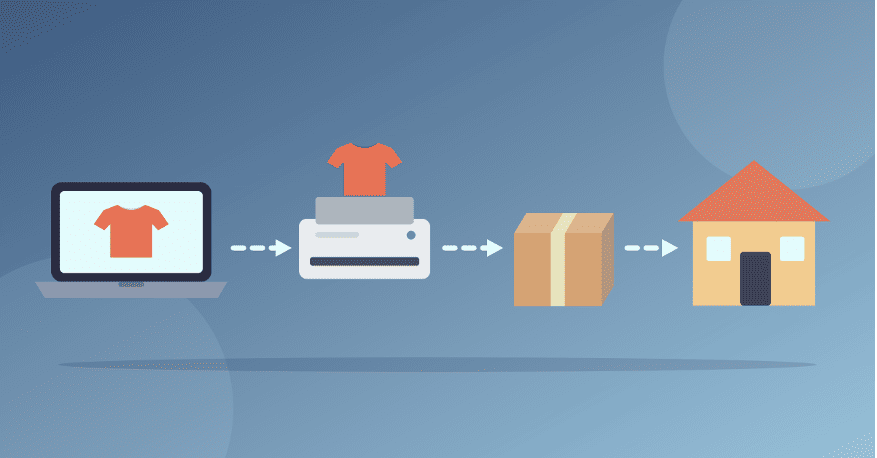
Most guides to custom-product dropshipping spend nine paragraphs explaining the concept and one sentence on money. That’s backwards. The concept takes thirty seconds to grasp: you sell products featuring your designs, a production partner prints and ships each order, and you never hold inventory. The money is where stores succeed or fail.
Industry estimates suggest that only a minority of dropshipping stores, often cited at around 10–20%, stay profitable over the long term. Experienced sellers commonly report net margins in the 15–20% range, while beginners frequently land below 10%. The difference rarely comes down to design talent. It usually comes down to whether the founder understood their unit economics before spending on ads.
So let’s do the math.
Table of Contents
Anatomy of a single sale
Take a mid-range custom hoodie sold at $40. The numbers below are illustrative, but their structure applies to almost every order.
| Line item | Example amount | Notes |
|---|---|---|
| Retail price | $40.00 | What the customer pays for the product |
| Shipping charged to customer | $0.00 | “Free shipping” is common, so the cost moves to you |
| Base product + printing | –$22.00 | Varies by blank quality and print locations |
| Shipping cost paid by seller | –$6.00 | Depends on destination and partner location |
| Payment processing | –$1.50 | Typically around 3% plus a fixed fee |
| Store platform and apps (per order share) | –$1.00 | Monthly subscriptions spread across orders |
| Contribution before marketing | $9.50 | About 24% of revenue |
| Customer acquisition cost (ads) | –$8.00 | Highly variable |
| Net profit per order | $1.50 | Under 4% |
That last line is the one that ends most stores. A $9.50 contribution sounds workable until a realistic ad cost erases it. Many first-time sellers price their products by looking at competitors rather than at this table.
Five levers that actually change the outcome
1. Price higher, and earn it
The biggest lever is the price itself. Moving that hoodie from $40 to $52, which is entirely reasonable for a well-designed piece on a quality blank, adds $12 of nearly pure margin. The way to justify a higher price isn’t discounting tricks. It’s a better product and a clearer brand: heavier fabric, a considered fit, original artwork, and photography that shows the garment on real people.
2. Raise average order value
Acquisition cost is paid per customer, not per item. A customer who buys a hoodie and a cap costs the same to acquire as one who buys only the hoodie. Bundles, “complete the look” suggestions, and free-shipping thresholds set just above your average order value all spread that cost across more revenue.
3. Lower acquisition cost through owned channels
Paid ads are the most expensive way to reach a customer. Email lists, organic short-form video, community engagement, and creator collaborations take longer to build but drive the long-term blended acquisition cost down. Stores that survive past their first year almost always have a meaningful share of sales coming from channels they don’t pay for per click.
4. Choose your production location deliberately
Since the United States suspended its $800 de minimis exemption on August 29, 2025, cross-border parcels have faced duties and, for many postal shipments, extra handling fees. For print on demand dropshipping, this makes the location of production and fulfillment a direct cost decision. Partners that produce in or near your main customer markets typically mean lower duty exposure, faster delivery, and fewer surprise charges at checkout.
5. Protect margin from returns and reprints
Every misprint, wrong size, or damaged parcel costs you twice: once in the replacement and again in customer trust. Detailed size charts with fit notes, sample-tested products, and a partner with a clear reprint policy all protect the margin you worked to build.
The free-shipping trap
Free shipping is one of the most effective conversion tools in ecommerce, and one of the most misunderstood. Shipping still costs money; offering it “free” simply moves that cost into your margin. McKinsey research has found that shipping cost now outranks delivery speed as the most important factor for many online shoppers, so removing it at checkout can lift conversion meaningfully. The mistake is removing it without adjusting price. If a hoodie costs $6 to ship, a “free shipping” hoodie needs roughly $6 more built into its retail price, or a free-shipping threshold set high enough that larger orders absorb the cost. Many sellers find a threshold slightly above their average order value works best, because it nudges customers to add a second item.
What healthy numbers look like
Benchmarks vary by niche, but the stores that scale tend to share a profile:
- Contribution margin before marketing of 35–45%, which leaves room for ads and profit
- Repeat customers making up a growing share of revenue over time
- A blended acquisition cost well below first-order contribution, so each sale is profitable on its own, not only over a customer’s lifetime
- Return and reprint rates in the low single digits
If your numbers fall well short of these, the problem is usually pricing or product, not traffic.
One more benchmark worth tracking is the share of revenue from repeat customers. Because returning buyers cost little or nothing to reacquire, every percentage point of repeat revenue lowers your blended acquisition cost and lifts overall profit.
A pre-launch worksheet
Before spending a dollar on advertising, fill in these figures for your three main products:
- Retail price
- Base cost including all print locations
- Average shipping cost to your top three customer regions
- Payment and platform fees per order
- Your maximum affordable acquisition cost (contribution minus target profit)
If the maximum affordable acquisition cost is lower than what ads in your niche realistically cost, adjust the price, the product, or the channel mix before launch, not after.
Bottom line
Custom-product dropshipping remains one of the lowest-risk ways to start an apparel business, because you never pay for unsold inventory. Low risk is not the same as high profit, though. Treat every product as a small profit-and-loss statement, price with your full cost stack in mind, and build channels you own. The founders who do this early are the ones still in business a year later.
