



Choosing a virtualization platform for enterprises isn’t easy. CTOs typically deal with multiple levels of dilemmas and doubts.
One of those doubts starts when they are already eyeing different options. They know that their present legacy stack is costing them more than it should. But, there’s still doubt.
Should we go for open source? Or is commercial enterprise-grade HCI the better way? That’s where the dilemma starts.
And just like that, you’re back at square one, justifying the stack you’ve built everything on.
It’s a fair question, honestly. The market has shifted, costs have climbed, and there are now more options than ever. But more options don’t always mean clearer decisions.
Table of Contents
The Real Dilemma Facing IT Teams Right Now
Virtualization isn’t going anywhere. It’s still the backbone of how most enterprise workloads run. The problem is, the conversation around which platform to bet on has gotten a lot messier.
On one side, you’ve got open-source tools like Proxmox and XCP-ng that offer zero licensing costs and serious flexibility. On the other hand, there are traditional commercial vendors that promise enterprise-grade reliability but come with price tags that are becoming harder and harder to justify.
Neither side is perfect. And that tension is exactly what’s making this decision so difficult for IT leaders right now.
Open Source Sounds Great Until It Isn’t
Look, there’s a reason open-source virtualization is appealing. No upfront licensing fees. No vendor lock-in. The ability to customize things at a deep level. For lean teams or smaller deployments, tools like Proxmox and XCP-ng can absolutely get the job done.
But at enterprise scale? That’s where things get complicated.
What are the hidden costs of running open-source virtualization at scale?
The short answer: people, time, and risk.
You need engineers who actually understand the platform at a deep level. Not just someone who can follow a tutorial, but someone who can debug a kernel panic at 2 AM or write custom integrations when something breaks. That kind of talent isn’t cheap, and it’s not easy to find.
Then there’s the patching. Open-source platforms don’t come with a vendor pushing security updates to you on a schedule. You’re responsible for staying on top of vulnerabilities, applying patches, testing them, and rolling them out without causing downtime. In a bare metal hypervisor environment running mission-critical workloads, that’s not a small task.
And if something goes wrong? There’s no SLA to fall back on. No support line to call. Just forums, documentation, and your own engineers trying to figure it out.
Commercial Platforms: The Value Is Real, But So Is the Pain
Enterprise-grade server virtualization software from established vendors gives you something open source can’t easily replicate: predictability. Dedicated support, tested integrations, compliance-ready security frameworks, and a roadmap you can plan around.
The problem is, the traditional commercial market has been going through a rough patch lately.
If you’ve been watching the Proxmox vs VMware and XCP-ng vs VMware debates online, you already know why.
Licensing changes from major vendors have pushed renewal costs to levels that feel punitive, especially for mid-sized enterprises. Teams that built entire infrastructures around these platforms are now scrambling to figure out their options.
It’s a real crisis, not just an inconvenience. Budgets are being blown, timelines are being disrupted, and IT leaders are being forced into decisions they weren’t planning to make.
The Enterprise Evaluation Matrix
When you strip away the noise, the enterprise hypervisor comparison really comes down to four things:
Total Cost of Ownership (TCO): Licensing fees are just one part of the equation. Operational labor, training, downtime costs, and migration expenses all factor in. A “free” open-source tool that requires three specialized engineers to maintain isn’t actually free.
Security and Compliance: There’s a big difference between building security on top of a platform and having it baked in from the start. Bolt-on security creates gaps. Built-in security is what enterprises in regulated industries actually need.
Operational Simplicity: Managing separate consoles for compute, storage, networking, and security is exhausting. It’s also a breeding ground for human error. Unified management isn’t just a convenience feature; it’s a reliability one.
Scalability: Your virtualization architecture needs to grow with your business, not become a bottleneck.
Who are the top enterprise-grade VMware competitors for data center migration?
The top market contenders for enterprise-grade VMware competitors include Sangfor, Proxmox, Nutanix, and Microsoft. The landscape includes familiar names in proxmox vs enterprise virtualization circles and newer players in the open source virtualization space.
But what’s interesting is that the best answer for most enterprises isn’t purely open source or purely traditional commercial. It’s about reducing downtimes, vendor support, and overall TCO reduction, all of which are very well handled by vendors like Sangfor.
Why Sangfor Is Worth Looking At
This is where Sangfor HCI enters the picture. It’s built around what Sangfor calls third-generation hyperconverged infrastructure, and the pitch is pretty straightforward: you get the affordability and flexibility that draws people toward open source virtualization, combined with the enterprise support, security, and simplicity that commercial platforms are supposed to deliver.
The numbers that get cited most often are around TCO reduction, with organizations reporting cuts of up to 70% when migrating from legacy commercial setups. That’s significant, especially for teams currently facing painful renewal conversations.
What sets Sangfor apart in the modern enterprise virtualization landscape is its ability to deliver a comprehensive, enterprise-grade cloud architecture without operational fragmentation. Rather than a loosely coupled set of tools, the Sangfor HCI framework integrates compute (aSV), fully distributed software-defined storage (aSAN), and visualized network virtualization (aNet), all orchestrated under the Sangfor Cloud Platform (SCP).
Crucially, for global multinational corporations where cyber resilience is paramount, Sangfor embeds aSEC directly into the hypervisor layer—delivering kernel-level native security, micro-segmentation, and proactive ransomware protection without requiring inefficient, external security bolt-ons.
Furthermore, looking ahead in 2026, a resilient infrastructure must be inherently AI-Ready. Sangfor structurally bridges this gap by natively integrating enterprise-grade Kubernetes (K8s) capabilities and advanced vGPU deep slicing and scheduling technologies at the core architectural level. This design ensures that enterprise IT teams can confidently sustain mission-critical legacy workloads today, and seamlessly spin up Private AI clusters and large language models tomorrow on the exact same hardware footprint.
Sangfor’s determination to provide resilient IT infrastructure and virtualization platforms goes beyond marketing. They have received back-to-back recognition as a leader in cloud computing from G2 in winter 2026 and summer 2026.
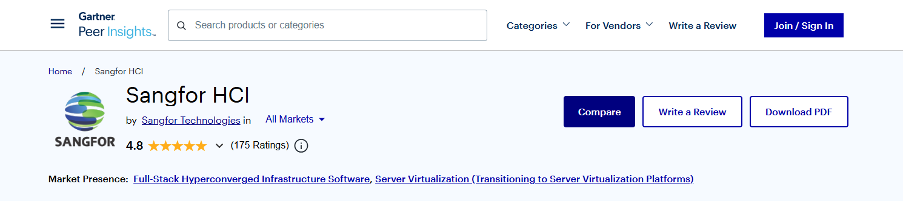
In addition, their standing in peer-review insights on recognized platforms like Gartner is also impressive. They are getting a 4.8/5 star rating from 175+ real users. That says a lot about an enterprise-grade solution if you were in the process of evaluating one.
What Real Enterprises Are Saying
Sangfor has earned strong marks in the Gartner Peer Insights “Voice of the Customer” report for Full-Stack HCI, including what the company notes is a 100% Willingness to Recommend score among verified enterprise users. That’s a metric worth paying attention to.
The case studies are also telling. The Ministry of Communications of Malaysia moved away from a traditional VMware environment to Sangfor HCI and resolved several compounding problems at once: licensing cost inflation, operational complexity from a three-tier architecture, and performance limitations on legacy workloads.
Nishat Emporium Mall and UNIKA Atma Jaya University both documented transitions that maintained uptime while simplifying their infrastructure significantly. These aren’t edge cases; they’re the kind of results that make other IT teams start asking questions.
So, Where Does This Leave You?
Decisions become clear as day when you know what your IT team really needs. So, if we were to give you one conclusive answer, we’d suggest that you calculate beyond the upfront licensing cost.
Think in terms of total cost of ownership, and the picture gets clearer. When you consider an open-source virtualization platform, a significant part of the cost doesn’t show up in the licensing. But it grows as you keep using it.
On the other hand, traditional commercial platforms offer reliability but have become increasingly difficult to justify on cost grounds. The sweet spot for most enterprises is a platform that doesn’t force you to choose between the two.
If your team is currently reassessing your virtualization strategy, whether because of licensing changes, cost pressure, or just a planned refresh cycle, it’s worth putting Sangfor HCI on your evaluation list. The commercial virtualization platform landscape has genuinely changed, and some of the newer options are worth a serious look.
Frequently Asked Questions
What’s the main difference between open-source and commercial virtualization platforms for enterprises?
Open source platforms like Proxmox VE and XCP-ng ask for no licensing fees and provide high flexibility. But they can hold back enterprises with inadequate internal expertise. In addition, open source platforms also usually don’t carry any vendor support SLAs. Commercial platforms change this by providing stability, dedicated support, and built-in security. But these platforms have a licensing cost attached, often with a subscription fee.
Is Proxmox suitable for enterprise use?
Technically, Proxmox is capable of handling enterprise workloads. But when it comes down to scaling it for specialized roles, you have to handle challenges around manual security patching and fragmented support. For large enterprises, the operational overhead that comes with Proxmox is often beyond the cost they can cut with free licensing.
What are the best VMware alternatives for enterprise data center migration?
The best VMware alternatives for enterprise data center migration are Sangfor HCI, Nutanix, Proxmox VE, and so on. However, the right choice depends on TCO requirements, support expectations, and the level of internal expertise the enterprise IT team has.
How much can enterprises save by switching from VMware to Sangfor HCI?
Sangfor HCI cites a TCO reduction of 70% for enterprises when migrating from traditional or legacy systems. It is the highest for any vendor for IT infrastructures to claim.
