


Table of Contents
Why Employees Don’t Move (Even When They Know They Should)
Here’s a paradox every HR leader understands:
People know movement is good for them—yet most still struggle to stay active.
This isn’t a knowledge problem. It’s a behavior problem.
Modern behavioral science shows that habits aren’t built on logic alone—they’re shaped by cues, rewards, and emotional reinforcement. In the workplace, where stress, sedentary routines, and digital overload dominate, movement often falls to the bottom of the priority list.
But something powerful is changing.
Forward-thinking organizations are leveraging smart incentives, gamification, and social psychology to rewire employee habits—transforming movement from a chore into something people want to do.
This shift is fueling the rise of the best employee reward platforms 2026, designed not just to reward outcomes—but to shape behavior itself.
The Science Behind Movement and Motivation
To understand why incentives work, we need to look at how the brain forms habits.
1. The Habit Loop: Cue → Behavior → Reward
Behavioral psychologist Charles Duhigg popularized the habit loop, which consists of:
- Cue – a trigger (e.g., notification, reminder)
- Routine – the behavior (e.g., going for a walk)
- Reward – the benefit (e.g., points, recognition, dopamine hit)
When repeated consistently, this loop becomes automatic.
The problem? Most workplace wellness initiatives fail to close the loop effectively—especially the reward part.
2. Dopamine: The Motivation Molecule
Dopamine is often misunderstood as a “pleasure chemical.” In reality, it’s a motivation driver.
- It spikes in anticipation of reward, not just after receiving one
- It reinforces behaviors that lead to positive outcomes
- It plays a key role in habit formation
This is why micro-rewards—points, badges, leaderboards—are so effective. They create frequent dopamine feedback loops, making behaviors like walking, exercising, or joining a challenge feel immediately rewarding.
3. Intrinsic vs Extrinsic Motivation
A common concern: “Do rewards kill intrinsic motivation?”
The answer is nuanced.
- Extrinsic rewards (points, vouchers) can kickstart behavior
- Intrinsic motivation (enjoyment, identity, belonging) sustains it
The most effective employee reward platforms blend both:
- Start with incentives
- Transition into identity-driven habits (“I’m someone who moves daily”)
Why Incentives Are Reshaping Workplace Wellness
Traditional wellness programs often fail because they rely on:
- One-time campaigns
- Passive education
- Generic incentives
Modern platforms take a different approach:
They Make Movement:
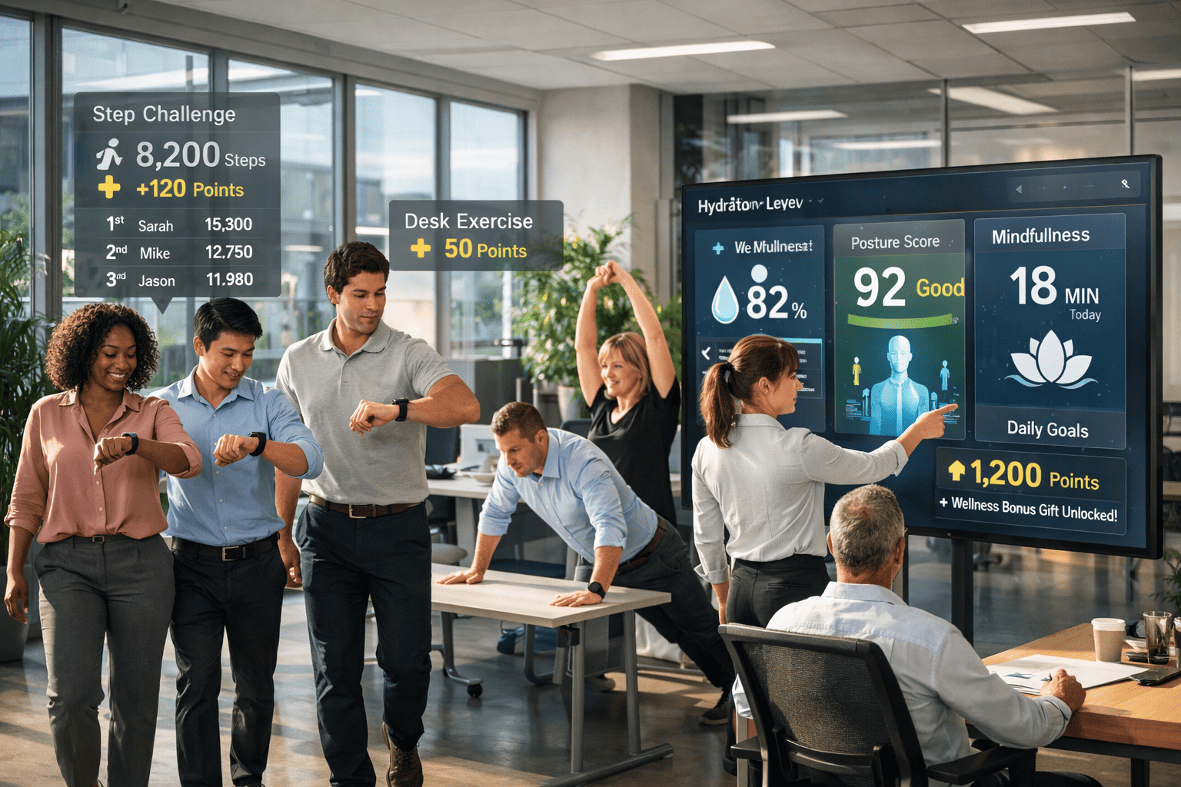
- Visible (leaderboards, tracking)
- Social (team challenges, shared progress)
- Rewarding (points, recognition, perks)
- Fun (gamification, storytelling)
This combination taps into multiple psychological drivers simultaneously:
- Competition
- Belonging
- Achievement
- Recognition
No surprise that companies investing in employee reward platforms are seeing higher engagement and measurable ROI.
Practical Reward Strategies That Actually Work
If you’re designing or upgrading a wellness program, here are proven strategies grounded in behavioral science:
1. Micro-Rewards Over Big Rewards
Instead of offering a large annual incentive, distribute small, frequent rewards.
Why it works:
- Reinforces behavior immediately
- Builds momentum
- Keeps dopamine loops active
Example:
- Earn points for every workout
- Daily streak bonuses
- Weekly mini-achievements
2. Gamification and Progress Tracking
Gamification isn’t just a buzzword—it’s a behavioral tool.
Key elements:
- Points systems
- Levels and milestones
- Leaderboards
- Visual progress maps
These create a sense of:
- Progress
- Achievement
- Friendly competition
3. Social Accountability
Humans are social creatures. We’re more likely to act when others are involved.
Tactics:
- Team challenges
- Activity clubs
- Peer recognition
- Social feeds
This taps into:
- Social proof
- Belonging
- Peer motivation
4. Personalization and Inclusivity
One-size-fits-all programs fail because employees have different:
- Fitness levels
- Interests
- Motivations
Best practice:
- Offer multiple activity types
- Use weighted scoring systems
- Allow self-paced participation
Inclusivity increases engagement dramatically.
5. Tangible + Emotional Rewards
Rewards shouldn’t just be financial.
Combine:
- Tangible rewards: vouchers, perks
- Emotional rewards: recognition, status, community
Employees often value recognition just as much as rewards.
Real-World Success: What High-Performing Programs Look Like
Organizations using advanced employee reward platforms are seeing impressive results:
- Up to 90% participation in challenges
- 5× higher retention rates
- Significant improvements in:
- Productivity
- Mental wellbeing
- Employee satisfaction
In many cases:
- 70% of users report improved wellbeing within weeks
- Previously inactive employees begin meeting global activity guidelines
- Stress levels drop significantly
The key? These programs don’t just encourage movement—they engineer it.
The Rise of Smart Employee Reward Platforms
As we look toward the best employee reward platforms 2026, a few defining characteristics are emerging:
1. AI-Powered Insights
- Predict engagement trends
- Personalize nudges
- Optimize reward timing
2. Wearable Integration
- Seamless tracking
- Real-time feedback
- Reduced friction
3. Cross-Platform Engagement
- Mobile-first experiences
- Remote-friendly design
- Global accessibility
4. Data-Driven ROI
- Measurable outcomes
- Health and productivity metrics
- Business impact tracking
Spotlight: A New Standard in Movement-Based Engagement
One platform pushing the boundaries of what’s possible is GoJoe – Employee Wellbeing Platform.
Rather than treating wellness as a checkbox exercise, GoJoe combines behavioral science, gamification, and social connection to drive sustained engagement at scale.
What Makes It Different?
1. Movement Becomes a Game
- Team challenges across 60+ activity types
- Weighted points systems for inclusivity
- Interactive maps and leaderboards
2. Rewards That Truly Motivate
- Employees earn points for activity with 2x value returned to users
- Redeemable across 3,000+ reward brands in 150 countries
- Zero waste model, ensuring full budget utilization
- Flexible rewards including move-to-earn, LSA, and recognition
3. Social Connection at Scale
- Activity clubs
- Social feeds
- Peer-driven engagement features
4. Built for Simplicity and Scale
- Self-managed platform with minimal admin overhead
- Seamless integration with wearables
- Track 70+ activities
- Fully customizable for organizations
Proven Impact
Organizations using GoJoe report:
- 90% average participation
- 70% improved wellbeing within 2 weeks
- 40% reduction in stress levels
- 67% increase in productivity perception
Trusted by global organizations including PwC, PayPal, and NatWest, GoJoe is redefining how companies engage their people through movement.
Why It Matters for HR Leaders
The real value of platforms like GoJoe isn’t just engagement—it’s transformation.
They help organizations become:
- More resilient
- More productive
- More connected
And in an era of hybrid work and burnout, that’s not optional—it’s essential.
How to Choose the Best Employee Rewards Platform
If you’re evaluating options, here’s what to prioritize:
Look for:
- Behavioral science-backed design
- Gamification features
- Strong reward systems
- Social engagement tools
- Data analytics and insights
- Global scalability
Avoid:
- Static, one-size-fits-all programs
- Limited engagement features
- Lack of measurable outcomes
The best employee rewards platform isn’t the one with the most features—it’s the one that changes behavior consistently.
Key Takeaways
- Movement is a behavior problem—not a knowledge problem
- Habit formation depends on consistent, meaningful rewards
- Dopamine-driven feedback loops are essential for engagement
- Social and gamified experiences dramatically increase participation
- The best employee reward platforms 2026 combine:
- Incentives
- Personalization
- Data insights
- Social connection
The Future of Workplace Wellness
We’re entering a new era where wellness is no longer passive—it’s engineered.
In the future:
- AI will predict disengagement before it happens
- Rewards will be hyper-personalized
- Movement will be seamlessly embedded into daily work life
- Wellness platforms will double as culture-building engines
Organizations that embrace this shift will gain a powerful competitive edge—not just in health outcomes, but in talent retention, productivity, and employer brand.
Final Thought
If you want employees to move more, don’t just tell them—it won’t work.
Design systems that make movement:
- Easy
- Social
- Rewarding
- Addictive (in a good way)
Because when behavior changes, everything else follows.
