


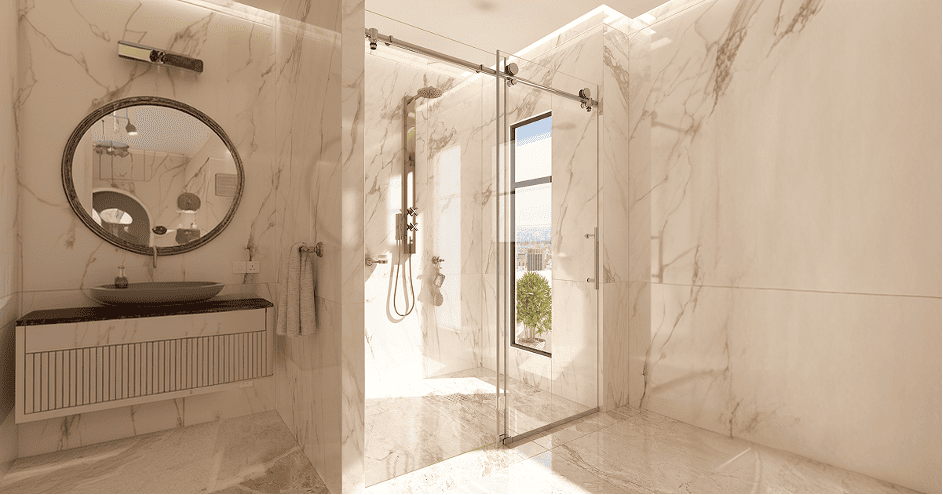
A frameless sliding door combines the clean appearance of exposed glass with a sliding mechanism that works well where a swinging door would take up too much bathroom space. It is especially common in alcove showers, tub-to-shower conversions, and contemporary bathroom renovations. But the minimalist appearance can be misleading. A frameless sliding shower door for bathtub depends heavily on accurate measurements, properly aligned walls and curbs, quality rollers, suitable safety glass, and correct installation. The door may look simple, but the system behind it has to handle substantial weight and repeated movement.
Understanding those factors makes it easier to determine whether this type of shower door is actually appropriate for your bathroom rather than choosing one based solely on appearance.
Table of Contents
Frameless Sliding Shower Door for Bathtub Explained
A frameless sliding shower door for bathtub uses large glass panels without the bulky metal perimeter frame found on traditional framed shower doors. Instead, the glass is supported and guided by a combination of rollers, tracks, brackets, guides, and other hardware.
Many systems use a bypass shower door configuration. Two glass panels overlap and slide past each other, allowing one or both panels to move depending on the design. This arrangement provides a wide entry area without requiring clearance for a hinged door.
The term “frameless” does not mean the enclosure contains no metal. Hardware remains necessary to support, guide, and operate the glass. What distinguishes the design is the absence of a conventional frame surrounding the edges of the glass.
Current U.S. retail listings show sliding frameless systems in several configurations, with common options including clear glass, different hardware finishes, soft-close mechanisms, and glass thicknesses ranging from approximately 1/4 inch to 3/8 inch or more.
How Does a Sliding Glass Shower Door for Bathtub Work?
The basic mechanism is relatively straightforward. One or more glass panels are suspended from or guided by a roller and track assembly. When the handle is pulled, the rollers allow the panel to travel horizontally rather than swinging outward.
The quality of this movement depends on several components. Rollers must carry the glass securely while moving smoothly. Tracks need to remain properly aligned. Guides and stops help control the panel’s travel and prevent excessive movement.
Some newer systems incorporate soft-close shower doors, which slow the panel near the end of its travel. This can reduce abrupt impacts against stops and make daily operation quieter.
The underlying principle has not changed: the sliding hardware must be correctly matched to the glass weight and installed on a structurally suitable surface.
Why Choose a Bathtub Sliding Shower Door?
It Saves Clearance Space
The biggest functional advantage is that the door does not swing into the bathroom. In a compact bathroom, that can make a meaningful difference.
A hinged shower door requires adequate clearance for its swing path. A sliding system keeps that movement within the shower’s footprint, making it useful for bathrooms where a toilet, vanity, wall, or other fixture sits close to the shower opening.
It Creates a More Open Appearance
Removing a bulky perimeter frame exposes more of the glass and reduces visual interruptions. Clear glass can also make the shower area feel more connected to the rest of the bathroom.
This does not physically increase the size of the room, but it can improve the perception of space, particularly in smaller bathrooms.
It Can Simplify Some Cleaning Tasks
Framed shower doors often contain metal channels and seals where soap residue, mineral deposits, and moisture can accumulate. A frameless design eliminates much of that perimeter framing.
However, calling frameless glass “maintenance-free” would be inaccurate. The glass still develops water spots and soap film, while the sliding track and rollers require attention.
What Are the Disadvantages?
The minimalist design has trade-offs that are easy to overlook. First, installation tends to be less forgiving. Frameless systems have fewer structural components to compensate for irregular walls or an uneven shower base. If the opening is significantly out of square, the door may not operate correctly or may require additional adjustment.
Second, sliding hardware introduces moving parts. Rollers can eventually wear, accumulate debris, or require adjustment. A poorly installed or low-quality roller system may produce noise, resistance, or uneven movement.
Third, a sliding enclosure can be more difficult to clean in certain areas because the overlapping panels and lower track create spaces that are less accessible than a simple hinged door.
So, the assumption that frameless automatically means “better” is too simplistic. The right choice depends on the bathroom’s dimensions, construction, maintenance expectations, and budget.
Glass Thickness and Safety Matter
One of the most important specifications is the glass itself. Shower doors in the United States are subject to mandatory safety requirements for glazing used in shower and bathtub enclosures. The U.S. Consumer Product Safety Commission notes that tempered glass is designed to break into small fragments rather than large sharp shards and identifies a mandatory federal safety standard for glass used in shower and bathtub enclosures.
The relevant safety-glazing framework includes CPSC 16 CFR Part 1201 and ANSI Z97.1. ANSI’s current 2026 edition establishes specifications and test methods for safety glazing materials used in buildings.
Glass thickness should not be considered in isolation. Thicker glass can affect weight, hardware requirements, handling, and installation. The appropriate specification depends on the particular door system and its engineering requirements.
For a shower renovation, look for properly certified safety glazing rather than assuming that thicker glass automatically means safer glass.
Frameless vs. Framed Shower Doors
The most useful comparison is not simply appearance versus appearance. It is how each construction method handles the realities of the bathroom. A framed shower door uses a metal framework around the glass. That framework can provide additional structural support and can make the system more tolerant of certain installation conditions. Framed models are also widely available in standard sizes.
A frameless design minimizes the amount of visible metal and generally provides a cleaner architectural appearance. It can also make the glass easier to visually integrate with tile, stone, and other bathroom finishes.
However, frameless construction typically places greater importance on accurate measurements and hardware installation. If the bathroom has walls that are substantially out of plumb or a curb that is not level, the installation needs to account for those conditions.
The better choice is therefore the one that matches the physical conditions of the shower, not whichever style happens to be more fashionable.
What Measurements Should You Take?
Accurate measurement is critical before ordering a sliding enclosure. Measure the finished opening at multiple points rather than assuming that one measurement represents the entire space. Walls can vary slightly from top to bottom, especially in older homes or remodeled bathrooms. The width and height should be checked according to the manufacturer’s measurement requirements. You should also determine whether the shower base or curb is level and whether the walls are plumb.
Tile thickness matters as well. Measuring before the final wall surface is installed can produce a substantially different opening than measuring the completed shower. For custom installations, the actual finished opening should be the reference point. Standard nominal dimensions are not a substitute for site measurements.
Which Hardware Finishes Are Most Practical?
Popular finishes include matte black shower door hardware, chrome, brushed nickel, and other metallic finishes. The choice is largely aesthetic, but maintenance can differ between finishes.
Chrome tends to have a traditional appearance and works with many bathroom styles. Brushed finishes can help disguise small water marks compared with highly polished surfaces. Matte black creates stronger visual contrast but can make mineral deposits more noticeable depending on water quality and cleaning habits.
Hardware material is more important than color. Components exposed to constant humidity should be appropriate for wet bathroom environments and compatible with the door system.
How to Keep Sliding Glass Doors Clean
Regular maintenance is more effective than occasional aggressive cleaning. After showering, using a squeegee on the glass can reduce the amount of water left behind. This matters because evaporating water can leave minerals on the surface, particularly in areas with hard water.
Periodic cleaning should address both the glass and sliding mechanism. Mineral deposits or debris around rollers and tracks can interfere with smooth movement.
Avoid assuming that every household cleaner is suitable for every finish. Abrasive products can damage certain hardware finishes, while inappropriate chemicals may affect seals or other components.
The goal is simple: remove moisture and residue before they become difficult deposits.
When Is This Type of Door a Good Choice?
A sliding frameless enclosure is particularly practical when bathroom space is limited and a swinging door would interfere with nearby fixtures. It can also make sense when the design calls for a visually open shower area without a large metal frame. Bathrooms with contemporary tile, large-format porcelain, stone surfaces, or minimalist fixtures can particularly benefit from the uninterrupted glass appearance.
On the other hand, it may not be the best solution for every opening. Very narrow shower openings, severely uneven walls, inadequate structural support, or unusual layouts may require a different enclosure configuration.
The decision should begin with the physical constraints of the shower and end with the aesthetic preference, not the other way around.
Common Installation Problems to Watch For
Several problems repeatedly come back to measurement and alignment. A door that does not stay aligned may have an issue with the track, rollers, wall conditions, or installation. A panel that feels unusually difficult to move should not simply be forced. Excessive resistance can indicate a mechanical or alignment problem.
Water escaping from the enclosure can have several causes, including the door configuration, seals, wall conditions, curb slope, or installation. No shower door should be treated as a completely watertight barrier; shower design and drainage also determine where water goes.
Another common mistake is treating the manufacturer’s rough opening dimensions as interchangeable with the finished opening. They are not. Always follow the specific measurement and installation requirements for the chosen system.
Are Frameless Sliding Shower Doors for Bathtub Worth It?
Whether the design is worthwhile depends on what you value. If your priority is saving bathroom floor clearance while maintaining a modern, open appearance, a frameless sliding system can be a practical solution. If your priority is maximum installation tolerance, the lowest initial cost, or the simplest possible hardware arrangement, another door configuration may make more sense.
The important point is that the “frameless” label alone does not determine quality. Glass certification, hardware design, measurements, wall conditions, installation technique, and maintenance all affect long-term performance.
For homeowners comparing shower enclosure options, those technical details are more useful than simply comparing photographs.
Final Takeaway
A sliding frameless shower enclosure offers a combination of space efficiency and minimalist design that works particularly well in many modern U.S. bathrooms. Its main advantages are the absence of a swinging door path, reduced visual framing, and a clean glass-forward appearance.
But it is not automatically the best shower door for every bathroom. Accurate measurements, compliant safety glazing, properly selected hardware, suitable wall and curb conditions, and careful installation are essential.
If you are comparing shower doors, evaluate the entire system rather than focusing only on glass thickness, hardware color, or appearance. That approach will give you a much better indication of how the enclosure is likely to perform after the bathroom renovation is finished.
