


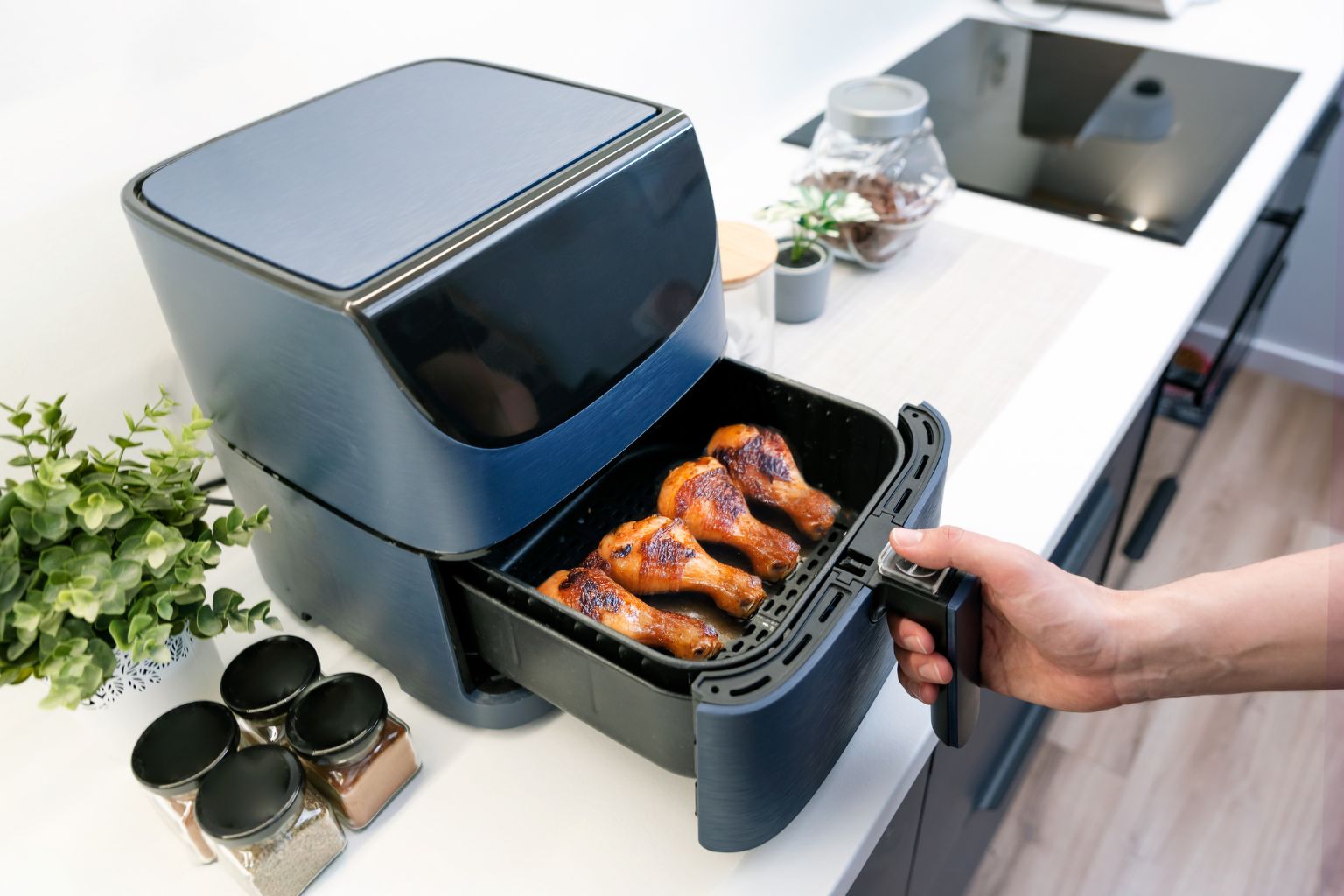
Nobody thinks hard enough about capacity before buying. That is genuinely the most common air fryer mistake, and it is also the most avoidable one. You buy something that looks reasonable, get it home, and discover on the first proper use that either the basket swallows two portions and leaves the rest waiting, or it cannot fit what a normal dinner for your household actually requires. The size question deserves more than thirty seconds of consideration.
Table of Contents
Small Households Have It Easier Than They Think
Here is the thing about cooking for one or two people. The compact end of the market, models in the 2 to 3 litre range, is genuinely well-designed for that use case and not in a compromised way.
An air fryer at this size draws somewhere between 800 and 1,100 watts. It heats up in under three minutes. The basket loads quickly, cooking time is short, and the whole process from start to plate takes less time than a conventional oven would spend preheating. For smaller households, that is a real daily advantage, not just a spec sheet number.
What people sometimes do is assume they should buy bigger for flexibility. Cook more when guests come over, that kind of reasoning. The tradeoff is running an oversized appliance at a fraction of its capacity most of the time, which affects both efficiency and cooking quality. Hot air circulation in a large basket with a small amount of food behaves differently from the same amount in an appropriately sized one. The results show it.
Three or Four People Is Where the Decisions Get Interesting
A family of three or four is honestly the trickiest group to advise because the right answer depends significantly on what and how they cook.
The 4 to 5 litre range covers most everyday meals for this household size without any batching required. A proper serving of roasted vegetables, a full tray of paneer, and a batch of stuffed peppers. It fits. The basket is large enough to cook a complete side dish in one go, which is what makes mealtimes actually work rather than just theoretically work.
But if this household batch cooks or regularly prepares multiple components simultaneously, a 5-litre single basket starts to show its limits. Not because of volume, but because a single temperature setting means everything in the basket has to cook under the same conditions. Not all food does.
That nuance matters more than most buying guides acknowledge.
Larger Families and the Dual Basket Question
Right. Six people or more. This is where the conversation changes completely.
Single-basket air fryers above 6 litres exist and can technically handle larger quantities. The practical problem is that cooking food in thick layers compromises the hot air circulation that makes an air fryer worth using. Stack things too deep, and you get uneven results, and uneven results with a large family mean someone is always eating something slightly wrong.
Dual basket models solve this more elegantly than simply scaling up. Two independent compartments, each with its own temperature and timer. You run both at once with different settings, which means a grain dish and a vegetable component finish at the same time despite needing different conditions. For a large family, that is the difference between an air fryer that integrates into daily cooking and one that becomes an occasional novelty.
For anyone comparing specific models, a well-organised air fryer selection with capacity and wattage clearly listed takes most of the guesswork out before purchase.
Cooking Habits Trump Headcount
This keeps getting underweighted in capacity discussions, and it should not.
A two-person household that meal preps every Sunday for the week has different requirements from one that cooks fresh every evening. The batch cooker needs more capacity. A family of four where children eat significantly smaller portions does not necessarily need what a standard family-of-four recommendation suggests.
The right question is not just how many people are eating. It is what a typical meal looks like, how it is prepared, and whether the basket can handle that realistically in one run.
Conclusion
Capacity decisions come down to three things used together. How many people are eating, what a typical meal actually involves, and whether cooking habits require flexibility in temperature or timing. Small households stay in the 2 to 3 litre range. Families of three or four land in the 4 to 5 litre bracket. Larger households should look seriously at dual basket designs. And everyone should think about how they actually cook before they think about how many people they cook for.
