



Most dog owners spend more time looking at the front of a packet than the back. The front tells you what the brand wants you to know first. The back tells you what is actually in the product.
Learning to read dog food labels properly takes about ten minutes. What you do with that information can make a meaningful difference to your dog’s diet over time.
This dog nutrition guide walks you through exactly what to look for, section by section.
Table of Contents
What Should You Actually Be Looking At?
1. Start With the Ingredient List
This is the most important section on any pet food label. Before anything else, this is where you find out what dog-safe ingredients are actually present and in what proportion.
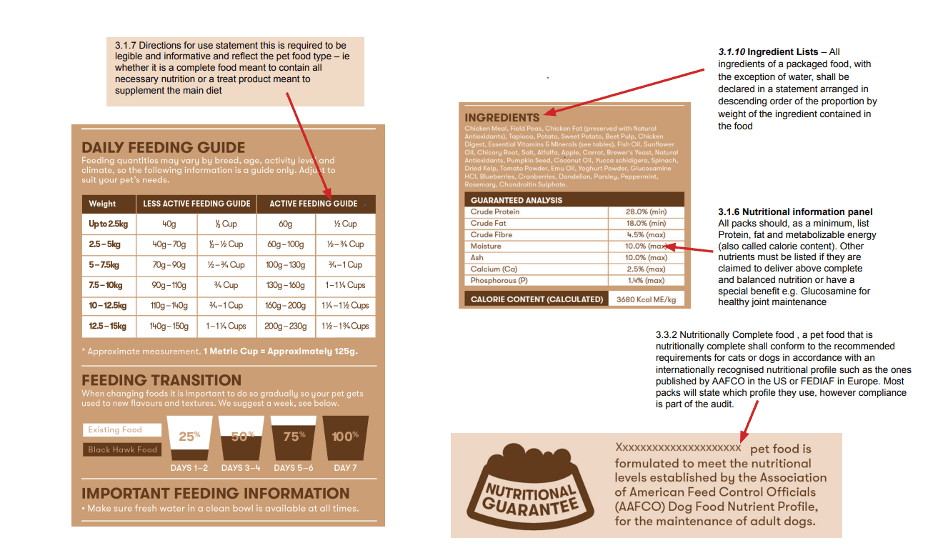
In Australia, ingredients must be listed in descending order by weight. Whatever appears first makes up the largest proportion of the product. Whatever appears last is present in the smallest amount.
What this means in practice:
If chicken is listed first, chicken is the primary ingredient. If corn or wheat appears first, that is what the product is mostly made of, regardless of what the front of the packaging claims.
Always look for healthy dog food ingredients listed by their specific name. “Chicken,” “beef,” and “kangaroo” are specific. “Meat derivatives” and “animal by-products” are not. Vague category terms tell you very little about what is actually in the product or where it came from.
What a transparent ingredient list looks like:
- Primary protein named specifically: chicken, beef, kangaroo
- Supporting ingredients named individually
- No broad category fillers in the top five ingredients
If preservatives are used, the label is required to name them specifically in Australia.
2. Understand the Nutritional Information Panel
Every compliant pet food label in Australia must include a nutritional information panel. At a minimum, this will show protein and fat levels. Many labels also include fibre, moisture, and energy content.
This is useful as a dog nutrition reference point, but it requires some context to interpret correctly.
What each figure tells you:
| Nutrient | What to Look For |
| Crude Protein | Higher is generally better for active dogs. Check the source, not just the number. |
| Crude Fat | Necessary for energy and coat health. Excessive fat warrants attention. |
| Crude Fibre | Supports digestive health. |
| Moisture | Higher in wet food. Relevant for hydration and calorie density calculations. |
The screenshot below illustrates what a standard nutritional panel looks like on an Australian pet food label, including guaranteed analysis figures and calorie content per kilogram.
One thing worth noting: the figures shown are minimum or maximum values, not exact amounts. Crude protein at 28% minimum means the product contains at least that amount, not exactly that amount.
3. Know What the Nutritional Adequacy Statement Means
This section of the label tells you something important: whether the product is a complete food or a complementary one.
- Complete and balanced means the product is formulated to meet all of a dog’s nutritional requirements. Supaw’s healthy dog treats and celebration products fall into this category.
- Complementary means the product is intended to be fed alongside other food. It does not cover all nutritional requirements on its own.
In Australia, the nutritional adequacy standard references the AAFCO nutrient profiles for dogs, which are regularly reviewed and updated based on current research. A label stating that the product meets AAFCO standards for a specific life stage indicates that the formulation has been assessed against a recognised framework.
4. Check the Directions for Use
Every compliant label includes a feeding guide. These are useful as a starting point, but they are not fixed rules.
What feeding guides account for:
- The dog’s weight range
- Activity level, with less active and active categories often shown separately
- Life stage where relevant
What feeding guides do not account for:
- Your individual dog’s metabolism
- Other treats or food given throughout the day
- Health conditions that affect intake requirements
Use the feeding guide as a reference, not a prescription. Your dog’s body condition, energy levels, and general health are better indicators of whether the amount is right. When in doubt, a veterinarian is the appropriate person to consult.
5. What the Date Label Is Actually Telling You
There are two types of date labels used on pet food in Australia, and they mean different things.
Best before: The product is safe to consume after this date, but may not be at its best quality. Most dry and shelf-stable products use this format.
Use by: The product should not be consumed after this date for safety reasons. This applies to products with shorter shelf lives.
For products with a shelf life of 2 years or more, a packaging date is required rather than a best-before date.
Storing products according to the label instructions is important regardless of the date format. An opened product stored incorrectly can deteriorate well before its stated date.
6. Apply This to Celebration Treats Too
The same label-reading skills apply to dog cake ingredients and celebration treats’ ingredients, not just everyday food.
When you are ordering a dog cake or cupcake for a birthday or special occasion, the ingredient list deserves the same attention as any other product. Look for named proteins, check for artificial additives, confirm whether any preservatives are used and what they are, and verify that the product is labelled clearly.
A quick checklist for evaluating any dog treat label:
- Is the primary protein named specifically?
- Are any artificial colours, flavours, or preservatives declared?
- Is added sugar or salt listed anywhere in the ingredients?
- Is the manufacturer’s contact information on the label?
Applying these dog nutrition tips to treat selection as well as everyday food gives you a complete picture of what your dog is consuming across the whole day, not just at mealtimes.
The Label Is There to Be Read
Dog food labels in Australia are governed by the Australian Standard AS5812, which specifies the information that must be included and how it must be presented. The framework exists to give owners the information they need to make informed decisions.
Most of the information is there. It just requires knowing where to look and what each section is telling you.
For a broader dog nutrition guide on feeding, treats, and ingredients, your veterinarian remains the most reliable source of advice specific to your dog’s individual needs.
