


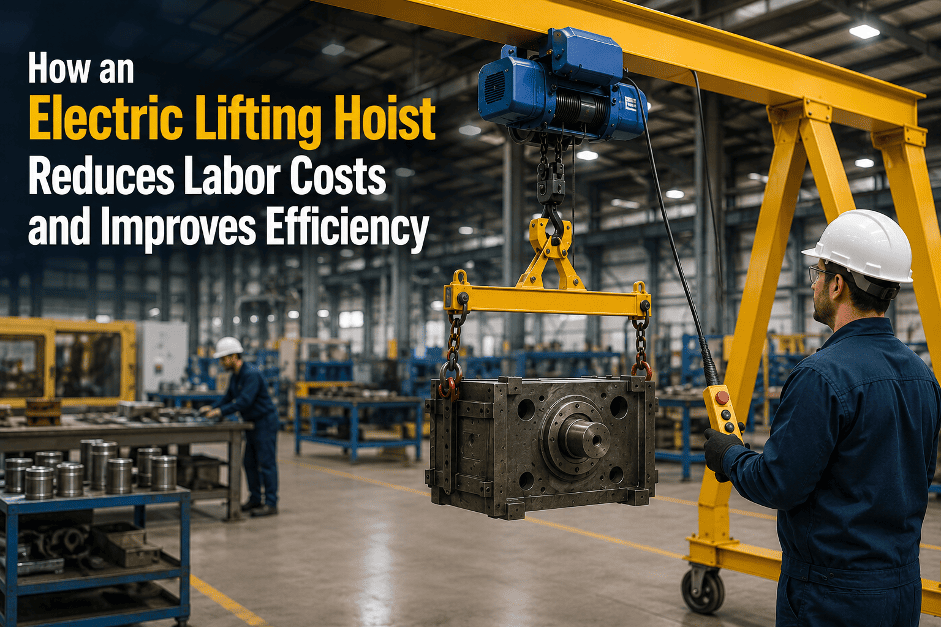
In today’s competitive industrial environment, businesses are constantly looking for ways to improve productivity while controlling operating expenses. Whether in manufacturing plants, warehouses, construction sites, or maintenance facilities, material handling plays a significant role in overall efficiency. One of the most effective solutions for streamlining lifting operations is an electric lifting hoist. By reducing manual labor, increasing workplace safety, and improving lifting precision, an electric hoist helps businesses complete more work in less time while lowering operational costs.
When paired with equipment such as an adjustable spreader beam or a light duty gantry crane, an electric lifting hoist becomes an even more versatile solution for handling loads of various shapes and sizes. This combination enables businesses to maximize productivity while maintaining safe lifting practices.
Table of Contents
What Is an Electric Lifting Hoist?
An electric lifting hoist is a powered lifting device designed to raise, lower, and position heavy materials using an electric motor. Unlike manual chain hoists that require physical effort, electric hoists automate the lifting process, allowing operators to move loads quickly and accurately.
Electric lifting hoists are commonly used in:
- Manufacturing facilities
- Warehouses
- Automotive repair shops
- Steel fabrication plants
- Distribution centers
- Construction sites
- Maintenance departments
- Machine shops
Available in various lifting capacities and lifting heights, electric hoists can be integrated into overhead cranes, gantry cranes, jib cranes, and monorail systems.
Reducing Labor Costs with an Electric Lifting Hoist
Labor is one of the largest operating expenses for most industrial businesses. Manual lifting often requires multiple workers to safely move heavy equipment or materials, increasing labor hours and reducing productivity.
An electric lifting hoist minimizes this requirement by allowing one trained operator to complete lifting tasks that would otherwise require several employees.
Some direct labor-saving benefits include:
- Fewer workers needed for lifting operations
- Reduced physical strain on employees
- Faster completion of repetitive lifting tasks
- Lower overtime costs
- Better allocation of skilled workers
Instead of assigning multiple employees to move heavy loads, businesses can dedicate personnel to higher-value tasks that improve overall production.
Improving Workplace Efficiency
Efficiency is about completing more work in less time without sacrificing quality or safety.
An electric lifting hoist significantly improves workflow by offering:
Faster Lifting Cycles
Electric motors lift and lower loads much faster than manual systems, reducing downtime between production processes.
Precise Load Positioning
Operators can accurately position equipment or materials exactly where needed, reducing unnecessary adjustments.
Continuous Operation
Unlike manual lifting equipment that quickly tires operators, electric hoists maintain consistent performance throughout the workday.
Better Workflow Organization
Materials move efficiently from one workstation to another, reducing production bottlenecks.
These improvements translate into higher daily output and greater operational efficiency.
Enhanced Workplace Safety
Workplace injuries caused by manual lifting remain a significant concern across many industries.
An electric lifting hoist helps reduce risks associated with:
- Muscle strains
- Back injuries
- Dropped loads
- Repetitive motion injuries
- Operator fatigue
Many modern electric hoists include advanced safety features such as:
- Overload protection
- Emergency stop controls
- Upper and lower limit switches
- Heavy-duty brakes
- Thermal motor protection
These features help protect both employees and valuable equipment.
Higher Productivity with Less Downtime
Downtime directly affects profitability.
Manual lifting often slows production due to:
- Worker fatigue
- Frequent rest periods
- Slow lifting speeds
- Limited lifting capacity
An electric lifting hoist keeps production moving efficiently throughout the day.
Benefits include:
- More lifts completed per shift
- Reduced idle time
- Improved production scheduling
- Consistent material flow
- Faster equipment installation
Over time, these improvements significantly increase production output.
Pairing an Electric Lifting Hoist with an Adjustable Spreader Beam
Certain loads require additional support to ensure balanced lifting.
An adjustable spreader beam is designed to evenly distribute load weight while preventing damage to long, fragile, or irregularly shaped materials.
When combined with an electric lifting hoist, the benefits include:
- Better load stability
- Reduced stress on lifting points
- Improved operator control
- Safer handling of oversized materials
- Increased lifting versatility
Industries frequently use adjustable spreader beams for:
- Structural steel
- Pipes
- Machinery
- Precast concrete
- Fabricated assemblies
- Large equipment components
The adjustable design allows operators to modify lifting points based on different load dimensions, making one beam suitable for multiple applications.
Using a Light Duty Gantry Crane with an Electric Hoist
A light duty gantry crane provides a portable overhead lifting solution for facilities that do not have permanent crane systems.
When equipped with an electric lifting hoist, this combination creates an efficient material handling system suitable for:
- Maintenance shops
- Warehouses
- Assembly lines
- Machine servicing
- Equipment repair
- Loading operations
Advantages include:
- Easy relocation
- Flexible work areas
- Lower installation costs
- No permanent building modifications
- Efficient lifting in temporary workspaces
For small and medium-sized businesses, a light duty gantry crane paired with an electric hoist offers exceptional value without the expense of installing a permanent overhead crane.
Applications Across Multiple Industries
Electric lifting hoists are used in a wide variety of industries because of their versatility and reliability.
Common applications include:
Manufacturing
Moving raw materials, machine parts, molds, dies, and finished products.
Warehousing
Loading trucks, stacking inventory, and transferring heavy pallets.
Construction
Lifting building materials, steel components, generators, and equipment.
Automotive
Removing engines, transmissions, and heavy vehicle components.
Fabrication Shops
Handling steel plates, welded assemblies, pipes, and fabricated structures.
Maintenance Departments
Safely lifting pumps, motors, compressors, and industrial machinery for repair.
Long-Term Cost Savings
Although purchasing an electric lifting hoist requires an initial investment, businesses often recover the cost through long-term savings.
Savings come from:
- Reduced labor expenses
- Lower injury-related costs
- Less equipment damage
- Increased productivity
- Reduced project delays
- Lower maintenance expenses
Businesses also benefit from improved employee morale, as workers spend less time performing physically demanding lifting tasks.
Choosing the Right Electric Lifting Hoist
Selecting the appropriate hoist depends on several factors.
Consider the following:
Load Capacity
Always choose a hoist rated above your maximum expected load.
Lift Height
Ensure sufficient lifting height for your workspace.
Duty Cycle
Facilities with continuous lifting operations require heavy-duty models designed for frequent use.
Power Supply
Verify compatibility with available electrical systems.
Speed Requirements
Some applications require faster lifting speeds to maintain production targets.
Safety Features
Look for overload protection, emergency stops, durable braking systems, and limit switches.
Working with an experienced lifting equipment supplier helps ensure the hoist meets operational requirements and industry safety standards.
Maintenance Best Practices
Routine maintenance extends equipment life and ensures safe operation.
Recommended maintenance includes:
- Inspecting wire ropes or chains regularly
- Checking hooks for wear or deformation
- Lubricating moving components
- Testing brakes and controls
- Inspecting electrical connections
- Verifying overload protection systems
- Replacing worn components promptly
Scheduled inspections help prevent unexpected downtime and costly repairs.
Conclusion
An electric lifting hoist is one of the most valuable investments businesses can make to improve material handling efficiency while reducing labor costs. By automating heavy lifting tasks, companies can increase productivity, enhance workplace safety, minimize employee fatigue, and reduce operational expenses.
When paired with an adjustable spreader beam, operators gain greater flexibility for handling oversized or uneven loads with improved balance and stability. Likewise, integrating an electric hoist with a light duty gantry Cranedepot creates a portable, cost-effective lifting solution that adapts to changing work environments.
Whether your operation involves manufacturing, warehousing, maintenance, construction, or fabrication, the right lifting equipment can transform workflow efficiency and deliver measurable long-term savings. Investing in reliable lifting solutions not only protects your workforce but also positions your business for greater productivity and sustainable growth in today’s demanding industrial landscape.
