


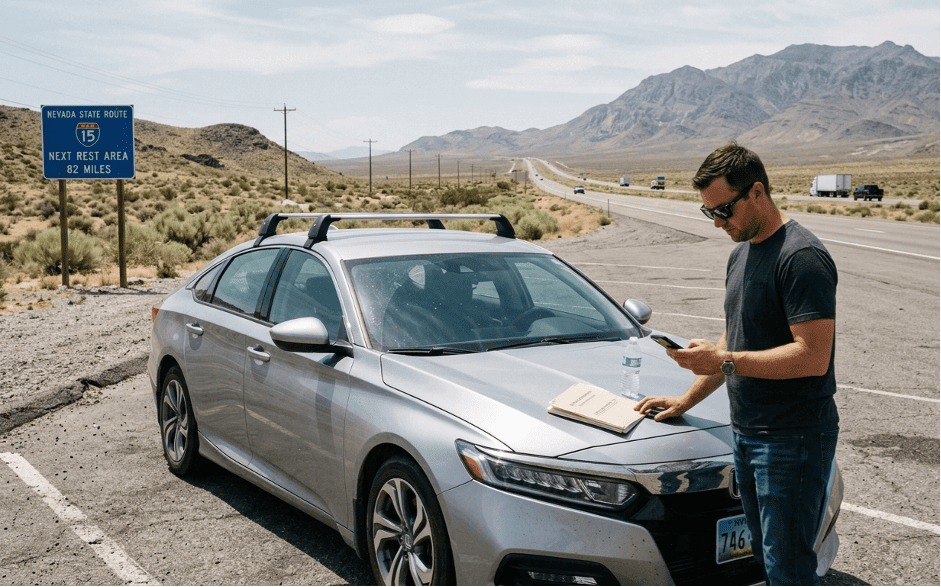
Somewhere between Ely and Fallon on US-50, your phone loses signal, the nearest gas station is 80 miles back, and a band of wild horses is grazing thirty feet off the shoulder. This is ordinary driving in rural Nevada, and it exposes a set of insurance gaps that don’t show up much if you’re only driving around Las Vegas or Reno.
Nevada’s long, empty highways create real risks that a standard urban-focused policy doesn’t always account for. Here’s what actually matters once you’re outside the metro areas.
Table of Contents
The Legal Minimum Doesn’t Change, But What You Need to Protect Does
Nevada requires 25/50/20 in liability coverage under NRS 485.185: $25,000 per person and $50,000 per accident in bodily injury liability, and $20,000 for property damage. That’s the same requirement whether you’re driving downtown Reno or 100 miles from the nearest town on US-93. What changes on a long rural highway isn’t the legal floor. It’s how much of your protection depends on coverage beyond that floor, particularly comprehensive coverage, which liability alone does nothing for.
Wild Horses and Open Range Are a Real Insurance Issue Here
This is the detail that catches a lot of drivers off guard, and it’s specific to Nevada in a way most states don’t share. Under NRS 568.360, owners of livestock running on open range have no legal duty to keep animals off a highway that crosses that range, and they generally can’t be held liable for a collision between a vehicle and the animal. Nevada also has a large population of feral horses in areas like the Virginia Range, spanning Fernley, Dayton, Silver Springs, and stretches along US-50 and Alternate US-95, and these animals often have no identifiable owner at all.
The Nevada Department of Agriculture and Nevada Department of Transportation have documented roughly 149 horse-related crashes in the Virginia Range area over a recent three-year stretch, with 25 resulting in human injury and two in death. If you hit a horse on an open range highway, there’s frequently no liability policy to pursue on the other side. Your own comprehensive coverage is what pays for the damage to your vehicle, not someone else’s insurance.
Nevada Has Been Actively Building Around This Problem
The state has taken the wildlife and livestock collision risk seriously enough to invest in infrastructure for it. The Nevada Department of Transportation has installed livestock fencing along sections of US-50 near Dayton, wildlife underpasses along I-80 between Wendover and Wells for mule deer migration, and bighorn sheep crossings as part of the Boulder City Bypass on I-11. More than 30 large wildlife crossings now exist statewide. That investment tells you something: this isn’t a rare or theoretical risk on Nevada’s rural highways, it’s common enough that the state has spent real money engineering around it.
Why Comprehensive Coverage Matters More on These Roads Than It Does in Town
In a city, comprehensive coverage mostly protects against theft, vandalism, and weather. On a rural Nevada highway, it’s frequently what pays for a genuinely likely event: an animal strike. Dropping comprehensive coverage to save money is a riskier trade if you regularly drive long stretches of US-50, US-93, or US-95 through open range country than it would be for someone who never leaves the Las Vegas valley or the Reno-Sparks area.
If you do carry comprehensive, think carefully before setting the deductible too high. A $1,500 or $2,000 deductible lowers your monthly premium, but a single wild horse or mule deer strike can total the front end of a vehicle, and if you don’t have that deductible amount available, the savings didn’t actually help you. A moderate deductible, somewhere around $500 to $750, tends to strike a better balance for drivers who put real miles on Nevada’s rural routes.
Remote Stretches Mean Roadside Assistance Isn’t Optional
US-50 through central Nevada carries the nickname “The Loneliest Road in America” for a reason. Long sections run without gas stations, cell service, or another vehicle in sight for extended stretches. A mechanical breakdown that would be a minor inconvenience in Las Vegas can become a serious problem out there, both in terms of safety and cost, since towing from a remote stretch of highway is far more expensive than a tow within city limits.
Roadside assistance coverage is usually a small add-on to a policy, a few dollars a month, but it’s worth confirming your specific plan covers long-distance towing, not just a flat tire change five minutes from home. If you’re planning a trip through central or eastern Nevada, it’s worth reviewing some general tips for driving on a highway before you go, particularly around vehicle prep and what to do if you break down somewhere without signal.
Uninsured Motorist Coverage Matters Differently Out Here
On a rural highway, a hit-and-run or an accident involving an uninsured driver is harder to resolve than the same incident in a city with traffic cameras and nearby witnesses. Nevada requires insurers to offer uninsured and underinsured motorist coverage, and you have to reject it in writing to go without it. Given how much harder it can be to identify or locate the other party after an incident on an isolated stretch of highway, this coverage is worth actively keeping rather than treating as an easy line item to trim.
A Practical Checklist Before a Long Nevada Drive
- Confirm you have comprehensive coverage, not just liability, especially if your route passes through open range country on US-50, US-93, or US-95.
- Check your deductible against what you could actually pay if an animal strike totaled part of your vehicle tomorrow.
- Verify your roadside assistance covers long-distance towing, not just short local calls.
- Confirm your uninsured motorist coverage is active rather than assuming it’s included by default.
- Fill up before long rural stretches and know where the next services are, since a breakdown far from town changes the math on everything above.
Comparing Coverage Before a Trip
If you’re planning regular travel across Nevada’s rural highways, it’s worth reviewing your policy against what those roads actually expose you to, rather than assuming a standard urban policy covers the same risks. Comparing auto insurance Nevada options with comprehensive coverage and adequate roadside assistance built in, rather than defaulting to whatever combination minimizes the monthly bill, is worth the extra time before a long trip rather than after a breakdown on an empty stretch of highway.
The Bottom Line
Nevada’s rural highways carry a different risk profile than its cities, and a policy built around city driving can leave real gaps once you’re past the last exit before open desert. Wild horses, remote breakdowns, and harder-to-resolve hit-and-runs are all part of driving this state’s long stretches. Building your coverage around that reality, rather than the state’s bare legal minimum, is the difference between a manageable incident and an expensive one.
