


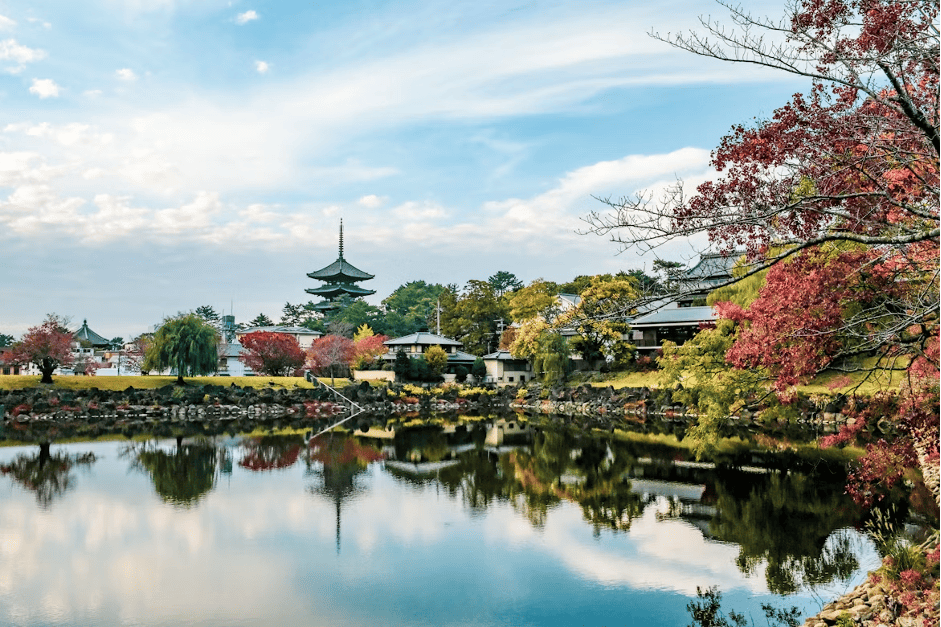
Ask most people about Nara, and you’ll get the same mental image: a deer politely bowing for a biscuit. Which, to be fair, isn’t wrong — those deer are wild, they’re absolutely everywhere, and they have zero problem giving you a good shove when you run out of food. But treating Nara as a photo-op with antlers means missing out on one of the oldest continuously running craft economies in Japan. This city was the capital way back in 710 AD — before Kyoto even got a turn. And you can feel that head start not just in the temples, but in the little shops too.
So let’s not pretend a magnet of a deer bowing for a cracker is the best we can do. Here’s what’s actually worth packing home.
Table of Contents
The deer are only part of the picture
So there are over 1,200 sika deer in Nara Park, and they’re not just locals—they’re practically divine. Protected as messengers of the gods since the 700s, all because some deity allegedly rolled in on a white deer to guard Kasuga Taisha. And the deer have never let anyone forget it. Not bad for a superstition — over 1,300 years and still going strong as government policy. Killing one used to carry the death penalty under Edo-period law, which tells you how seriously this got taken.
The deer are worth seeing. They’re just not worth buying, if that makes sense — a stuffed toy version tells you nothing about the place. What tells you something is the stuff made by hand, nearby, using techniques that predate the deer legend by centuries in some cases.
Where the actual shopping happens
Which brings us to Higashimuki shopping street. Most people walk from Kintetsu Station straight to the park, and this street is right in the middle of that walk. So you’re going to see it. “Facing east,” they call it — a name that dates back to when shops lined only the west side of the street, their storefronts facing east toward Kofukuji. There are dozens of shops and food spots on a 220-meter-long street. Walking it takes several minutes. Planning for it? Take at least an hour.
And unlike a lot of souvenir strips built purely for tourists, this one still functions as a real shopping street for locals — grocery stalls sit next to century-old sweet shops, which sit next to places selling handmade brushes. That mix is the point.
What’s actually worth buying there
A few categories rise above the rest, and it’s worth knowing what to look for before wandering in blind:
- Nara-zarashi linen — a bleaching technique for hemp and ramie cloth that dates back roughly 1,300 years and was once so prized it supplied cloth to samurai households.
- Fude brushes — Nara is one of Japan’s historic centers of calligraphy-brush production, known for the traditional nerimaze method of blending different animal hairs. A single high-end brush can take weeks to finish.
- Kuzu-mochi and other kuzu-based sweets — made from Japanese arrowroot starch, a Nara specialty since the Edo period, with a wobbly, almost translucent texture nothing outside Japan really replicates.
- Deer-shaped sweets and sake cups, sure, but look for the ones made by small confectioners rather than mass-produced boxes near the station exit — the difference in taste is not subtle.
Prices vary wildly depending on the shop, and haggling isn’t really a thing here, but quality differences are usually obvious once items sit side by side.
A small practical note
Anyone planning the day around this stretch might want to loop in a guided walk — companies like GetExperience offer to book small-group tours through Nara that weave the shopping street into a broader route.
Either way, the real souvenir isn’t the object. It’s remembering that this street has been doing exactly this — feeding, clothing, and delighting visitors — for longer than most countries have existed. A magnet just can’t carry that.
