


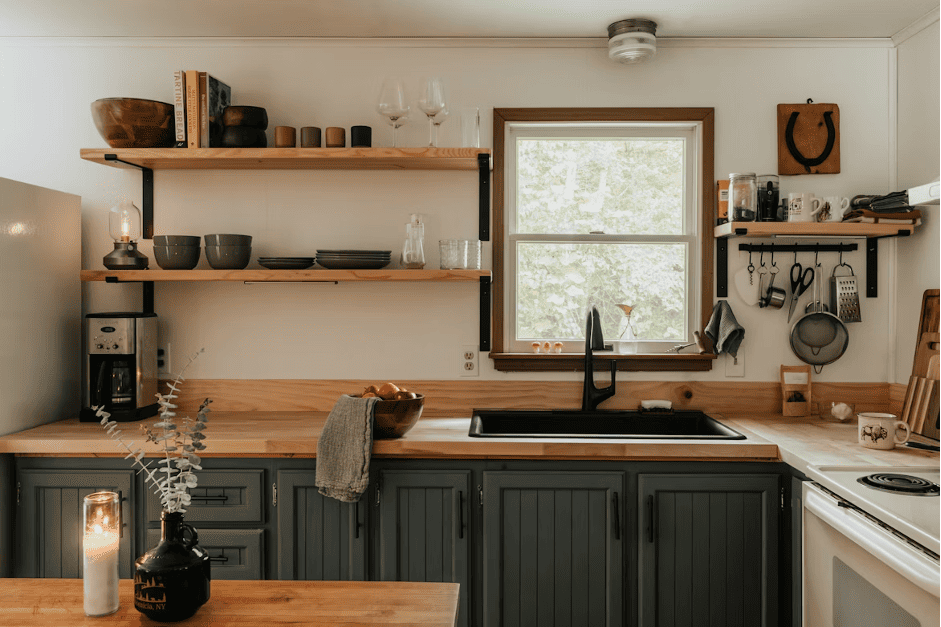
There’s a certain kind of kitchen that causes you to lose track of time: you come in to get a drink of water and twenty minutes later you’re sitting on the counter eating crackers and chatting about something unrelated to why you came in. They are not necessarily the most costly, and they are certainly not always equipped with the greatest tools. Something else is going on with them.
Warmth in a kitchen is one of those concepts that everybody nods at and almost nobody can define properly. Ask ten designers and you’ll get ten different answers, most of them involving the word “layered”. Which is true but not very useful if you’re standing in a showroom trying to make actual decisions with actual money. So let’s try to be more specific about it.
Table of Contents
Materials First
The materials you touch in a kitchen are more important than those you see, which seems paradoxical until you consider how you move around the room. You’re not looking at a kitchen from across the room. You’re in it, with your hands on the surfaces, pulling drawers, leaning against edges, and pushing objects. The physical input from such materials accumulates in ways that circumvent cognitive appraisal totally.
Wood is the most obvious example and also the most misunderstood one. It fell out of fashion during the granite-and-steel decade when the aspirational kitchen aesthetic was basically “professional restaurant, but at home”. Cool, hard, slightly intimidating. Wood got associated with a certain dated Scandinavian-pine look and a lot of people walked away from it. Which was, in retrospect, a mistake.
The current interest in custom wood countertops isn’t nostalgia. It’s a response to surfaces that seem pricey yet feel like nothing. End-grain walnut, live-edge maple, and salvaged fir from someplace other than your kitchen. Each one is unique, altering over time, producing markings and color changes that no factory finish can match. Yes, they need maintenance. You have to oil them, you have to think about what you put on them. Some people find that annoying. Others find that the ongoing small act of caring for a surface is exactly what makes it feel like theirs.
Lighting
Walk into any kitchen renovated in the last ten years and look at the ceiling. There it is – the grid of recessed LED downlights, perfectly spaced, covering the whole room with flat, even light from directly above. Efficient. Bright. And somehow completely at odds with any sense of warmth or intimacy.
However, direct downward light removes shadow depth and makes surfaces read as cold and clinical. And add a wrong temperature to this.
Color temperature is the most common error made when selecting kitchen lighting, and it’s an easy one to make since the numbers seem abstract. However, 2700K to 3000K is the range that seems warm to the human eye; it is near to incandescent, the reference point against which “cozy light” has historically been measured. Above 3500K, you’re in office-building territory. Below 2700K, everything starts to resemble a candle store. The sweet spot is limited yet easy to detect.
Layers matter as much as temperature. Under-cabinet lights for actual task work. Pendants hung low over an island – low enough to create a concentrated pool of light rather than just adding more ceiling brightness. Maybe a strip inside glass-front upper cabinets, which adds depth and visual breaks up that flat wall of cabinetry that would otherwise just read as furniture. These three sources together give the kitchen a time of day. Bright at noon, different at seven. That transition is what makes a kitchen feel inhabited versus functional.
The Details That Are Easy to Dismiss and Probably Shouldn’t Be
There are a few categories of renovation choice that almost never come up in the big-picture budget conversation and consistently end up being what people either love or wish they’d done differently. Hardware is one. Shelving philosophy is another.
On hardware: unlacquered brass and aged bronze age in a way that polished chrome simply doesn’t. They accumulate fingerprints, they shift color, they become specific to the kitchen they live in. That process is often listed as a maintenance concern in product descriptions and is actually a feature. A drawer pull that seems to have been pulled thousands of times has a different quality than one that appears to have just come out of a box, even if they are the same price.
On shelving:
- Open shelving with actual objects on it reads as warm in a way that closed cabinetry can’t fully match. The randomness signals that people are in there, cooking, reaching for things. Research in environmental psychology has found this fairly consistently: spaces showing evidence of habitual use are rated as more comfortable than clinically organized ones.
- The same logic applies to color. Earth tones – terracotta, sage, warm charcoal, clay – have been returning to kitchens steadily. That’s not a microtrend. Those colors have been in domestic architecture for centuries. Ochre in Egyptian homes. Iron oxide red in Roman ones. Something about them keeps being right.
None of this is revolutionary advice, which is maybe the point – the things that work in kitchens have been working for a very long time, and the renovation industry keeps discovering them like they’re new.
The Longer View on All of This
The kitchens that date badly are almost always performing something. A trend, a moment, an idea of what a kitchen was supposed to look like in a specific year. The ones that hold up were built around a different question – not how should this look but how should this feel to be in, every day, for a long time.
